Gentle, specially tailored treatment
for the dog you love.
Clinical canine massage therapy that supports mobility, eases discomfort and helps your dog recover, rest and move more freely — delivered with the calm, careful touch your dog deserves.
Approved member & bound by the Guild's code of conduct
Two-year Practitioner Programme, Canine Massage Therapy Centre
Up-to-date training & full insurance cover
It started with a Basset Hound called Bilbo.
My name is Joanne Rawlings and I'm the owner of Severn Clinical Canine Massage Therapy, based in Upton upon Severn. I came into the world of canine complementary therapy in 2021 — rather spontaneously — after seeing what it did for my own dog.
That summer my Basset Hound, Bilbo, suffered a spinal disc extrusion and lost control of his hind legs. After forty-eight hours under the care of a veterinary hospital, the decision was made to try a course of hydrotherapy in an underwater treadmill. Within three months he had regained control of his hind legs and no longer needed help with toileting or getting around.
Before his injury at age four, Bilbo had regular maintenance massage with a rather wonderful clinical canine massage therapist — purely down to my paranoia about his breed and the issues they're predisposed to. I genuinely believe that without all that bodywork in the years beforehand, he would never have made such an incredible recovery.
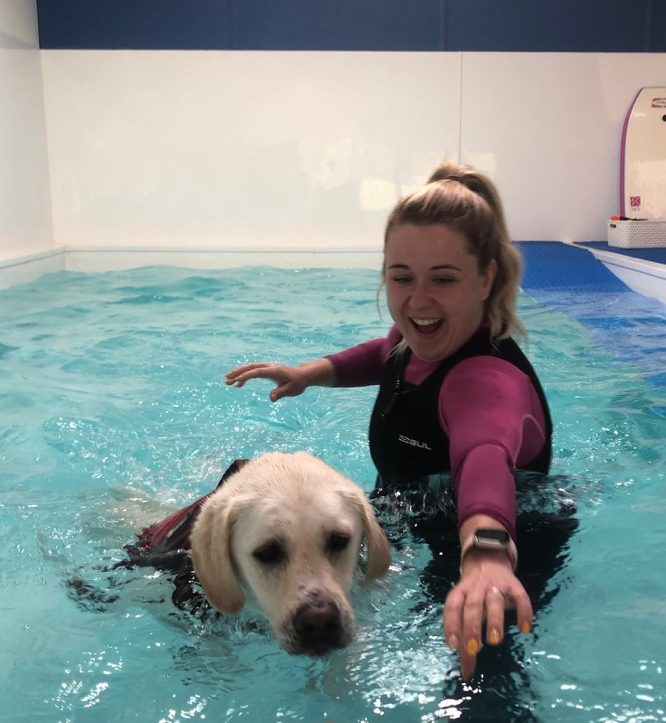
I've now been a qualified canine hydrotherapist for over four years, working at Malvern Canine Hydrotherapy, and I'm a Clinical Canine Massage Therapist, having completed the phenomenal Practitioner Programme with the Canine Massage Therapy Centre — the qualification behind my registration with the Canine Massage Guild. I work closely with vets and tailor my approach to each and every treatment.
Results you can see, in just 1–3 sessions.
At Severn Clinical Canine Massage Therapy the aim is to achieve results within one to three sessions. Using the Lenton Method® — the only clinically trialled method of canine massage worldwide — treatment can resolve or reduce the effect of a wide range of orthopaedic and muscular issues, improving your dog's comfort and their range of movement.
It is also an effective treatment for the sporting dog, reducing the likelihood of injury and assisting with preparation and recovery around events.
-
Four massage disciplinesDirect, remedial techniques combined and tailored to your dog
-
The Lenton Method®Advanced myofascial release — the only clinically trialled canine massage method
-
A home care planSo the benefit holds between sessions and you know what's driving the issue
Are you seeing any of these in your dog?
These are the signs owners most often notice first. Any one of them can point to soft-tissue pain that your dog has quietly been working around.
- Lameness or limping
- Stiffness
- Difficulty going up or down stairs
- Problems getting in or out of the car
- Slowing down before their time
- Hopping or skipping on back legs
- Performance issues in sporting dogs
- Slowing down on walks, or disinterested
- Gait or posture irregularities
- Neck, back or shoulder issues
- Reluctant to be petted, groomed or examined
- Nerves or anxiety
- Crying in pain, or yelping
- Arthritis or hip dysplasia
- A change in behaviour — snappy, or depressed
- Self-mutilation — biting or nibbling the rear end or wrists
What soft-tissue issues may be causing it?
Strains
A tear to the muscle, and the most common muscular injury there is. It can happen at any age.
Trigger points
Hyperirritable bands in the tissue that cause both local and referred pain.
Myofascial pain
A chronic pain disorder caused by restrictions in the connective tissue surrounding the nerves.
Overcompensation
Weight-shifting away from an area of injury or arthritis, creating new areas of painful tension.
Protective muscle splinting
Commonly associated with muscle having to work too hard because of orthopaedic issues such as hip or elbow dysplasia.
Your dog's first appointment.
Your first visit is unhurried — usually 60 to 90 minutes — because getting to know your dog properly is where good treatment begins.
Before any hands-on treatment can happen I need your vet's consent — that comes first, every time. Here's how that works.
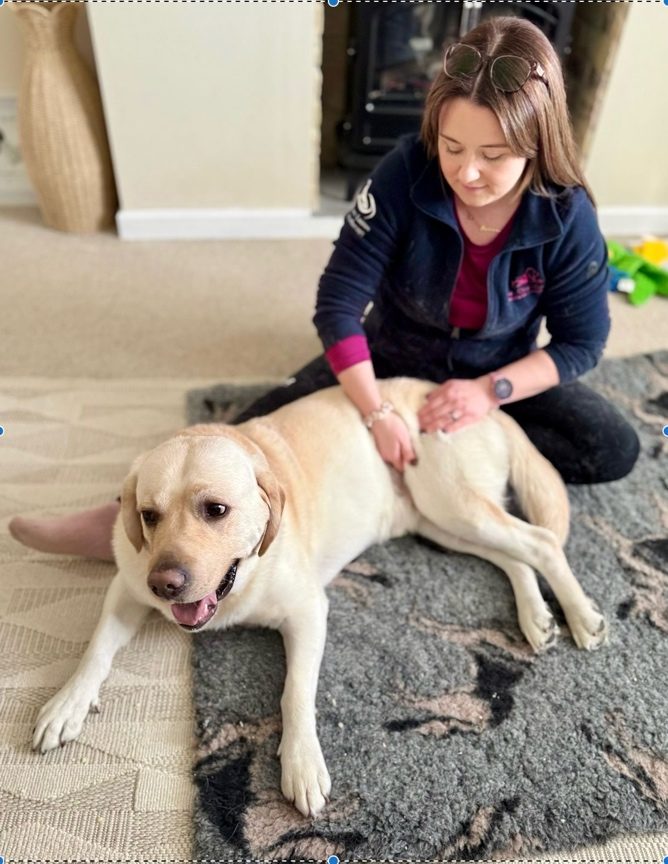
We start with a proper conversation: your dog's diet, general lifestyle and medical history, the niggles you've noticed and what your vet has said. Where it's appropriate I'll watch your dog move — gait and posture tell me a great deal about where they're compensating — followed by an initial palpation to pinpoint the soft tissue that needs attention.
From there, the treatment itself: a full-body massage tailored to what I've found, worked at a pressure and pace your dog is comfortable with. Most settle quickly; many drift off entirely. You'll get feedback on what I've found, along with aftercare advice to keep the benefit going at home.
This is a results-driven practice — the aim is to improve what you're seeing in one to three sessions. I work to best practice, so in the unlikely event that we see no improvement after the third session, I won't keep treating your dog. I'll refer them back to your vet for further exploration, with a written report of anything I've identified, because that's the right thing to do.
Why your vet signs off first.
Before any hands-on treatment, your dog needs the all-clear from your vet. It's a legal requirement — and honestly, one I'm glad exists, because it keeps your dog safe.
Under the Veterinary Surgeons Act 1966 and the Veterinary Surgery (Exemptions) Order 2015, hands-on therapy to treat a problem must be carried out with your vet's consent: they examine your dog first and refer them on. It means nothing gets missed. To keep things simple and safe, I ask for vet consent for every dog I work with.
In practice it's straightforward. Download the form below, take it to your vet to complete and sign, then email it to me or bring it to your first appointment. I'm happy to arrange it with your practice directly if that's easier.
One thing to plan around: I won't treat your dog within two weeks of them having had their vaccinations, or any spot-on flea treatment. That's to make sure everything has settled and we're not overloading your dog — so please let me know when you book. The same care applies after surgery or injury: we'll always time treatment around your vet's advice. Once consent is in place we're good to go, and I'll continue to communicate with your vet while treatment is underway — they can also opt in on the consent form to receive a written report after your dog's initial sessions.
A simple, four-step journey.
From first message to long-term care — here's what to expect.
Enquire
Send a quick message or call. We'll talk through your dog and check we're a good fit.
Vet consent
We obtain vet consent for treatment — a legal requirement and the right thing for your dog.
First session
A relaxed, in-depth consultation followed by hands-on treatment tuned to your dog.
Aftercare
Aftercare advice, home-care guidance and follow-up, so we know exactly how things are progressing.
Simple, transparent pricing.
Every dog begins with an initial consultation — this is where we understand the full picture before any hands-on work begins.
Initial Consultation
A thorough first assessment for new clients, including gait analysis, discussion and a full treatment.
- Full consultation — diet, lifestyle & medical history
- Postural & gait analysis where appropriate
- Initial palpation
- Full-body massage & aftercare advice
Follow-up Treatment
Targeted, hands-on treatment building on what we learned in your initial consultation.
- Full-body assessment
- Targeted hands-on treatment
- Tailored home-care advice
- Aftercare advice after every session
The same price applies at the clinic in Malvern Hills Veterinary Practice and for home visits. A £5.00 travel fee applies to visits more than 10 miles from Upton upon Severn (WR8 0PQ). Payment by bank transfer or cash only.
The dogs can't speak for themselves — so their owners do.
Real stories from owners who've watched their dogs change after just a few sessions.
Folly has really slowed down recently — she is stiff in her back legs and seems painful in her lower back, grumbling when she changes position. I was keen to try massage therapy again as she has had good results with it in the past. Jo was very empathetic with Folly and always respectful of her boundaries. Since her treatment, Folly has been stretching more than usual and has rolled on her back for the first time in years. She has also been more cheeky! We are very much looking forward to the next treatment.
Toby has good days and bad days. He can be very stiff and lame, and can struggle to stand after he has been lying down. Jo handled Toby very sympathetically — she was very calm and reassuring. Toby has since had fewer spells of lameness and has been more mobile. We will be looking to continue treatment with him.
Domino had been struggling with a flare-up — frequent lameness, and struggling to get on and off furniture or manage the stairs at home. Jo was nothing but wonderful throughout. She handled him with exceptional understanding, patience and kindness, always taking time to read his moods and adjust her approach. Domino visibly improved after the first session — walking up and down the stairs was a big one. Throughout the treatment he seemed happier and more himself, like he wasn't in pain any more. I would recommend canine massage to anyone with a dog like mine.
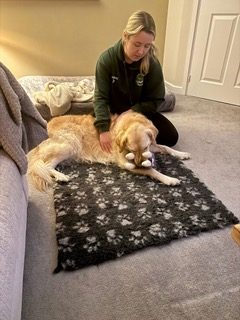
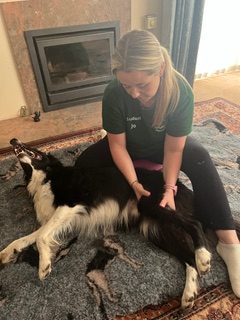
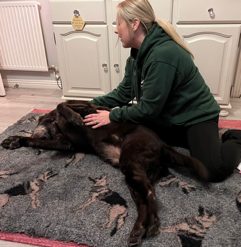
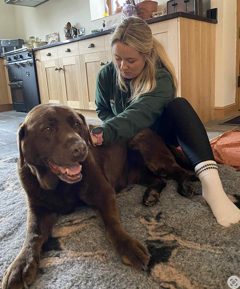
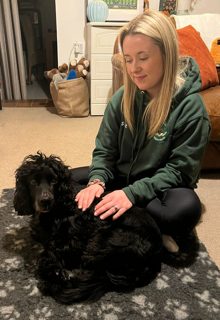
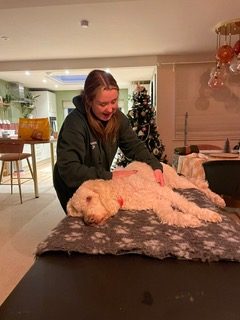
Moments from the table.
A selection of Jo's photographs of treatment sessions and the dogs she works with.
Before you book.
If your question isn't answered here, just drop me a message — I'm always happy to talk things through before any commitment.
Ask a questionDo I need a vet referral first?
How long is a session?
How many sessions will my dog need?
Where do sessions take place?
What if my dog is nervous or reactive?
How will I know if it's helping?
What does it cost, and how do I pay?
Tell me about your dog.
Fill in the form and I'll come back to you within 24 hours — or if you'd rather, give me a call. The more you can share, the better I can prepare for your dog's first session.
Based in Upton upon Severn, Worcestershire. As a mobile therapist I cover Worcestershire, Herefordshire and Gloucestershire, and I also have use of a treatment room at Malvern Hills Veterinary Practice in Hanley Swan.